Rabies vaccine
Schedule question
Separate line or combined vaccine allowance?
Evidence needed
Applicable routine-care grid

Look for the vaccination line in the routine-care schedule, not just the illness-insurance label.
Use these checkpoints to frame the literal question before reading the full guide.
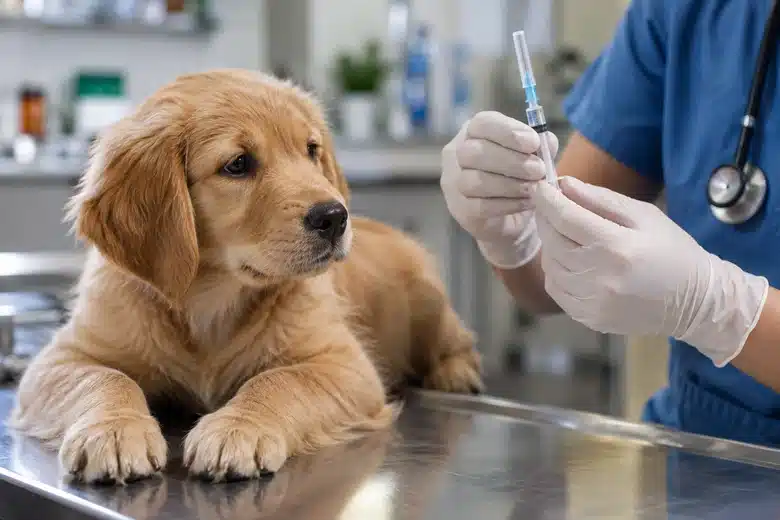
Dog insurance vaccinations require a preventive-benefit check. Separate the vaccine itself, the wellness examination and any treatment of illness. A benefit schedule may group vaccines under one allowance, so a list of vaccine names does not necessarily give each one a separate payment limit.
The sections below show how to verify the answer and what can change it.
Pets Best’s routine-care page, checked October 8, 2026, shows more than one grid. One lists rabies separately at $15 and vaccination/titer at $30 or $40 for its two tiers, with a $50 wellness exam line. Another combines vaccinations/titer at $45 or $55. Do not add both layouts together or assume either is your applicable schedule.
| Service | Schedule question | Evidence needed |
|---|---|---|
| Rabies vaccine | Separate line or combined vaccine allowance? | Applicable routine-care grid |
| Distemper/parvovirus combination | Which vaccine bucket applies? | Invoice and benefit definition |
| Bordetella or other recommended vaccine | Shares a cap or has its own? | Named benefit wording |
| Titer test | Substitutes within vaccine allowance? | Exact category definition |
| Wellness examination | Separate exam allowance? | Itemized fee and schedule |
| Treatment of illness | Not routine vaccination | Accident/illness policy review |
The insurer page is useful evidence that the grouping question matters, but it is not an individualized endorsement. Publication date is unstated. Applicable version, benefit period and state-specific selections must be resolved before treating a displayed amount as an entitlement.
Consider an entirely fictional routine-care design with a $50 combined vaccine allowance and a separate $40 exam allowance. Suppose the eligible vaccine bill is $75 and the exam costs $60. With both allowances unused, the maximum under those invented lines is $50 + $40 = $90; $45 remains from the $135 bill. If only $20 vaccine allowance remains, the corresponding maximum becomes $20 + $40 = $60.
Unused exam allowance is not automatically transferable to a vaccine charge. In the example, an owner who skips the exam cannot assume its $40 increases the vaccine cap. Nor should a once-a-year allowance be multiplied by the number of injections. Confirm how combination products, repeat doses and benefit-year boundaries are treated.
Keep policy terms, deductible, reimbursement and limits beside the quote so the comparison stays consistent.
Let the veterinarian determine the appropriate vaccine plan for the dog. Insurance arithmetic should not become a reason to give unnecessary doses or skip recommended care. Keep vaccination history with the dog’s records so that a repeated invoice line is not mistaken for a fresh unused allowance.
The current webpage contains multiple benefit presentations, and the operative routine-care schedule for a specific offering was not obtained. The public amounts are attributed examples, not a universal vaccination promise.
Do not assume so; inspect the preventive benefit separately.
Only if the applicable schedule actually provides separate allowances.
Keep the policy terms beside the price, then continue to rates when the comparison is clear.